Garry Kasparov’s Chess Legacy Extends Beyond the Board
The 2026 Hall of Fame inductee reflects on chess as a mental sport, his matches with Deep Blue, and decades of work supporting young players.
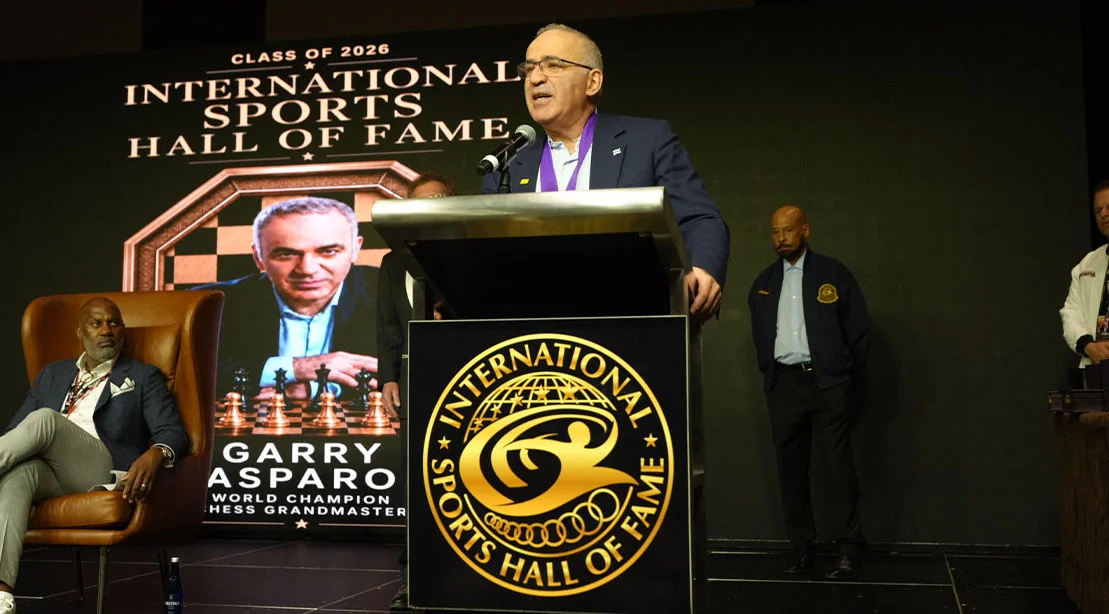
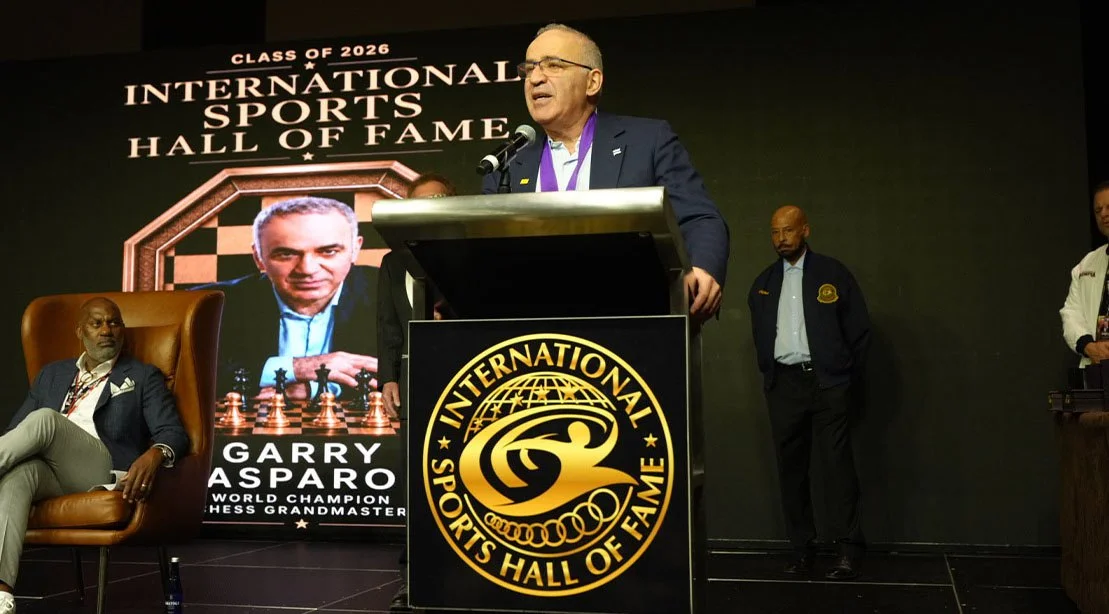
Garry Kasparov’s induction into the International Sports Hall of Fame’s Class of 2026 gave the former world champion another chance to make a case for chess as a sport. At the September 26 ceremony, he argued that competition depends on mental focus and fortitude as well as physical performance. His own career, from a record-setting run at the top of chess to matches against a supercomputer and work with young players, gives that argument a personal history.
Kasparov thanked the Hall of Fame for helping settle the long-running debate over chess’s place in sport. He joked that he didn’t resemble fellow inductee and Mr. Olympia winner Dexter Jackson, but said chess tests capacities that matter across athletics. “Chess is in many ways the purest expression of the mental focus and fortitude necessary to achieve greatness in just about any other sport,” he said.
A fast rise to the world title
Born in Baku in 1963, when the city was part of the former Soviet Union and is now in Azerbaijan, Kasparov learned chess from his father. His parents shared an interest in the game, and his father taught him its rules. After his father died in a car accident when Kasparov was seven, his mother continued to support his interest by enrolling him in a chess circle at the Baku Young Pioneer Palace.
Kasparov entered an elite chess school at age 10. It was run by Mikhail Botvinnik, a former world champion who became his mentor. Botvinnik recognized the boy’s exceptional memory and ability to calculate long sequences of moves. That training helped set Kasparov on a path to the highest level of the game.
In 1985, at age 22, Kasparov defeated Anatoly Karpov to become the 13th World Chess Champion, then the youngest person to hold the title. Karpov was 34. “It convinced me that I could play a much bigger game,” Kasparov recalled at the ceremony.
His success lasted well beyond that first title. He held the official International Chess Federation (FIDE) championship from 1985 to 1993 and the Classical World Championship title until 2000. He was ranked world No. 1 from 1984 until he retired in 2005. His FIDE rating reached 2851 in 1999, a record that stood until Magnus Carlsen passed it in 2013.
Deep Blue brought chess into a new conversation
Kasparov’s matches against IBM’s Deep Blue computer became a landmark in the public discussion of what computers could do. In their first six-game match, in 1996, Kasparov won 4–2. IBM upgraded the machine, and Deep Blue won their 1997 rematch by 3.5–2.5. The result brought attention to the contest between human judgment and computer calculation, while also prompting Kasparov to learn more about computer science and consider how he could contribute beyond chess.
Work beyond competition
After retiring in 2005, Kasparov turned much of his attention to activism and human rights work. He became a prominent critic of Russian leader Vladimir Putin and attempted to run for Russia’s presidency in 2008. He withdrew after he was unable to rent a hall large enough to gather the number of supporters required for his bid.
Kasparov has described facing surveillance, physical harassment and repeated short detentions during street demonstrations. In 2013, as he faced the prospect of arrest, he left Russia and later became a Croatian citizen. He has also spoken of arriving in the United States with a sense of hope, recalling how people on the other side of the Iron Curtain had viewed the country.
Kasparov said that by 2015 his name had disappeared from Russian sport records. In 2022, Russia designated him a “foreign agent.” His work has continued: he chaired the Human Rights Foundation from 2011 to 2024, supporting the organization’s focus on human rights in authoritarian societies. In 2017, he founded the Renew Democracy Initiative, which works to strengthen liberal democracy in the United States and elsewhere. He also coordinates with an exiled Russian anti-war opposition coalition and opposes Putin’s rule and Russia’s invasion of Ukraine.
Supporting chess’s next generation
Kasparov remains active in chess through tournament organization, mentorship, exhibitions and public analysis. He helped launch the Grand Chess Tour, a series of international tournaments for highly ranked grandmasters, and continues to share views on world championship matches and leading players.
He still plays in selected exhibitions, including a 2025 match with Viswanathan Anand and a 2026 match with longtime rival Veselin Topalov. Much of his education work runs through the Kasparov Chess Foundation, a nonprofit he founded in 2002. The foundation supports chess education and the development of young talent through mentorship, training camps, digital learning platforms and coaching clinics. Kasparov said that nearly every American grandmaster under 35 has taken part in one of its programs.
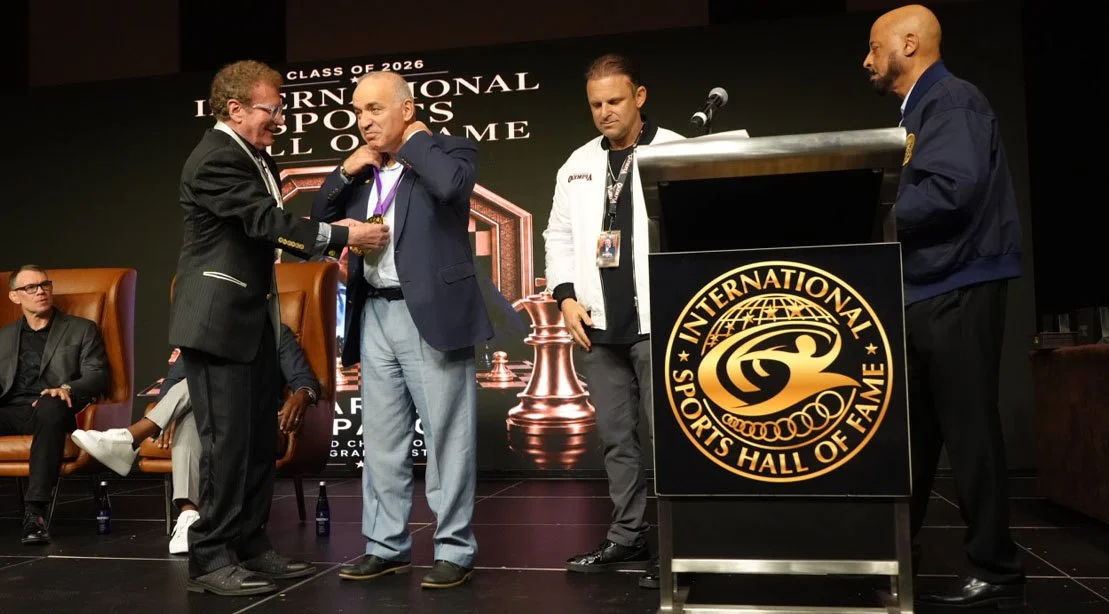
At the ceremony, Kasparov congratulated Jackson, Forrest Griffin, Vitomir Maričić and the Harlem Globetrotters, who were also named to the 2026 class. He said he hoped the honor would help draw attention to his efforts to renew American democracy and prepare it for new challenges. For Kasparov, the induction links two lasting commitments: making the case for chess’s demands and helping others develop their ability to meet them.
The full 2026 ISHOF Induction Ceremony is available to watch on YouTube. For more on the ISHOF, go to ishof.net.
===