Synthetic Cell Research Advances, but Scientists Still Debate What Counts as Life
SpudCell completes a cell-like cycle, while key limits remain. Researchers are also testing how life began and how to measure lifelike systems.
Building a cell from nonliving materials is no longer only a thought experiment. Kate Adamala’s SpudCell can take in food, grow, copy its DNA and divide. Yet it cannot make its own protein-making machinery, pass its full genetic material through more than a few generations, or evolve independently. The work marks a notable step in assembling cell-like functions, while leaving open the harder question: what would it take to make something that scientists agree is alive?
That question draws researchers with different aims. Some investigate how chemistry on early Earth might have crossed into biology. Others construct simplified cells to learn how living systems work and, eventually, to give them useful tasks. A third line of work asks whether systems built from unfamiliar ingredients could meet common descriptions of life. Across these efforts, the obstacle is much the same: individual life-like functions are increasingly possible, but getting them to work together inside a self-sustaining system remains difficult.
SpudCell illustrates both the progress and the gap. Adamala, a synthetic biologist at the University of Minnesota, announced the system in July. It is built from nonliving components, including a membrane-forming fatty material, genetic material and a prepared mixture of enzymes borrowed from existing organisms. The reported research has not yet been peer reviewed or published in an academic journal, so its results should be read as an early research claim rather than a settled finding.
A cell-like cycle, with important limits
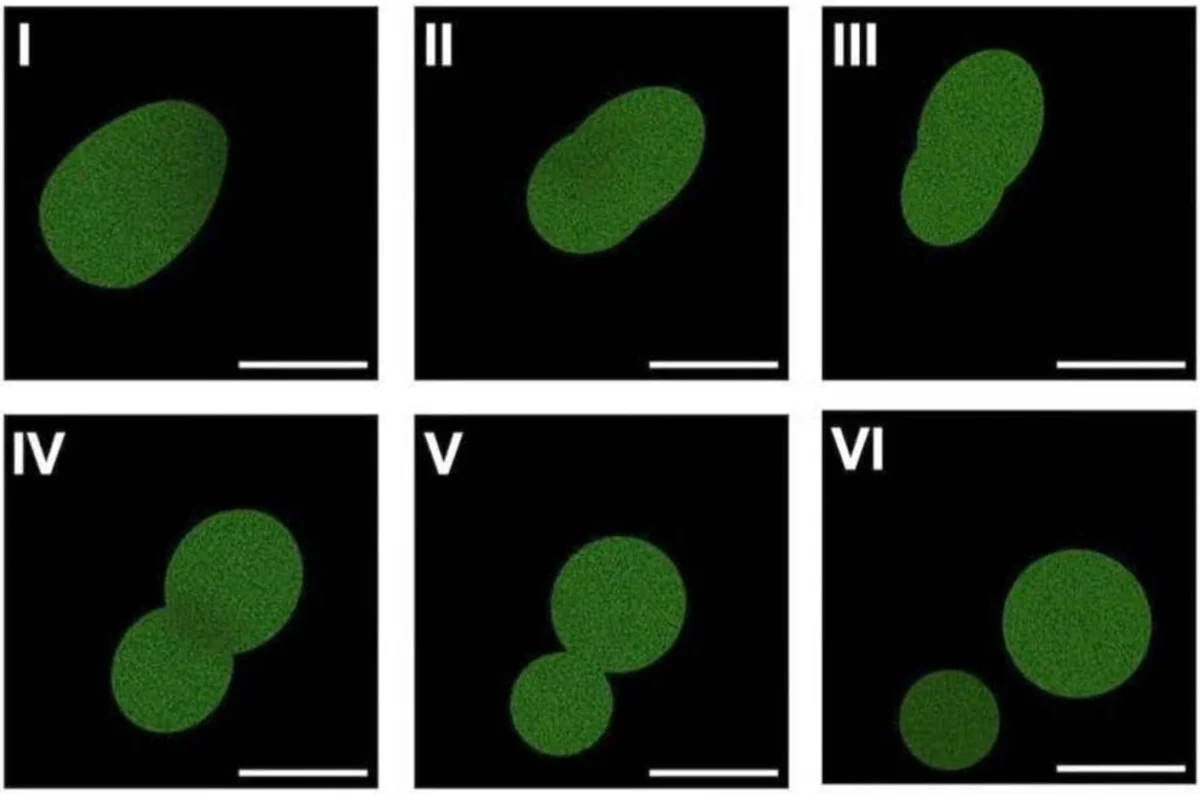
SpudCell’s membrane forms a small compartment around DNA or RNA. In natural cells, genetic instructions help direct the production of proteins; in this system, supplied molecules carry out some of those jobs. SpudCell can use proteins it produces to take in a specialized food source. As it grows, a protein causes the membrane to bend inward. The indentation deepens until the compartment splits, producing a new cell-like structure.
The system uses about 90,000 genetic base pairs. That is enough for the reported functions, but not enough to make SpudCell independent of the prepared ingredients that support it. It cannot build the machinery needed to make its own proteins. Nor has it shown that its complete genome continues through many generations. Those limits matter because a brief sequence of cell-like actions is different from a population that can maintain itself and adapt.
The researchers also reported a simple population-level change. They made a modified SpudCell that took in food more efficiently, then mixed it with the original version. The modified cells consumed more of the food and became more common. Adamala described this as a kind of early evolution. It demonstrates competition between two versions of the system, but it does not establish that SpudCell can generate and pass on useful changes through independent evolution over time.
That distinction helps explain why scientists generally do not call SpudCell alive. Many descriptions of life include the ability to reproduce, use energy through metabolism, respond to surroundings, maintain an internal environment and evolve. SpudCell displays some related functions, but it does not bring all of them together independently. Researchers also lack a shared formal definition of life, making a simple yes-or-no verdict difficult even when an experiment produces several familiar traits.
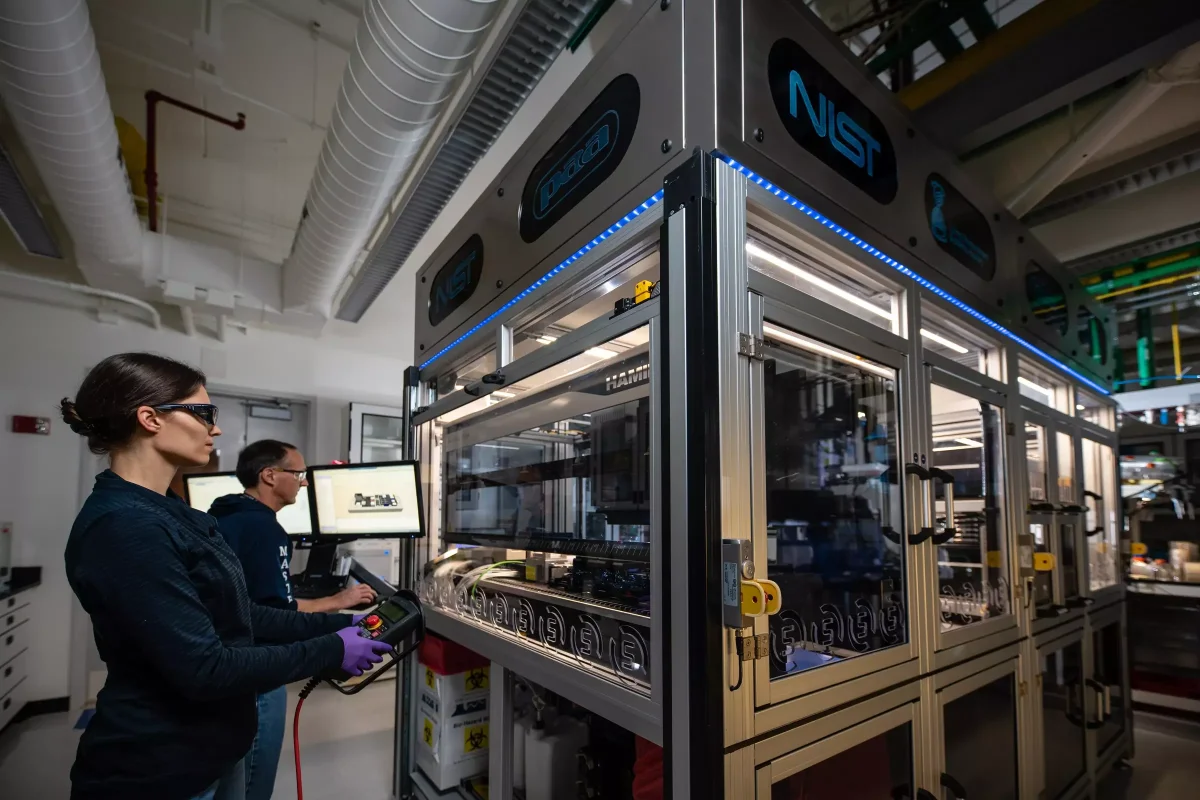
Elizabeth Strychalski, who leads the Cellular Engineering Group at the National Institute of Standards and Technology, describes the challenge as getting the parts to do more than sit near one another. For years, she said, the hope was that putting the right ingredients together in physical proximity would somehow make life emerge. That transition has not happened. As she puts it, a new system will not announce its status by climbing out of a laboratory dish.
Two routes toward the same puzzle
The effort to build cells has two broad strands. Origin-of-life researchers ask how the first biological systems could have emerged from the chemistry of early Earth. Synthetic biologists such as Adamala use a wider set of modern tools to study how cells function and to build systems that might perform defined tasks. The approaches differ, but both use construction as a way to test ideas about what life requires.
Adamala started with research into life’s origins and moved toward synthetic biology after graduate school. She has said she wanted work that remained fundamental and discovery-driven while also leaving room for practical uses. That mix drew her to simplified cells made from known ingredients. Such systems can help researchers ask which components are necessary for particular functions and which parts of natural cells may not be required for a basic cell-like process.
Her broader interest includes the possibility of using engineered cells to make chemicals now obtained from petroleum or to support future medical treatments, including cancer therapies. Those are possible directions, not demonstrated uses of SpudCell. The cell’s components can also join with one another, a feature that may help researchers investigate how cell-like systems could interact with natural cells or release useful molecules outside their membranes. Any such application remains a future research question.
Adamala and a collaborator have started a nonprofit organization, Biotic, with the stated aim of making SpudCell an open system that others can license for research. An open platform could let more teams examine its design and explore what changes are needed for different experiments. The immediate scientific value, however, is more basic: each known component gives researchers a way to probe how specific ingredients contribute to growth, division and other cell-like behaviors.
The origin-of-life route places tighter limits on what researchers can use. Scientists such as Jack Szostak, a Nobel Prize-winning chemist at the University of Chicago, try to model conditions and materials that might resemble those on early Earth. His group studies compartments made from fatty acids with RNA inside. In suitable conditions, these structures can divide and distribute RNA between the two resulting compartments. His lab has also made cell-like structures in which RNA can produce a copy of itself internally.
Szostak’s team has recently explored whether circular arrangements of RNA segments might help explain genetic replication. The idea arose through conversations during the early months of the Covid-19 pandemic, when lab access was limited. Adamala completed graduate work in Szostak’s laboratory, and their research shares the basic idea of enclosing genetic material in a simple membrane. The difference lies partly in the question each group prioritizes: how early cells could have formed, or how cells can be built and made to work now.
Clues from RNA and early chemistry
At Harvard University, astronomer Dimitar Sasselov helped establish the Origins of Life Initiative about two decades ago. He became interested in what Earth was like when life began and how early organisms may have changed the planet. The group brought together researchers from different areas of science, including astronomy, geology, chemistry and biology, because no single discipline can answer the full question.
Sasselov’s own research examines how RNA interacts with amino acids and short chains of amino acids called peptides. Rather than trying to assemble a complete cell, he studies how small molecules might have combined into early biological building blocks. His team also investigates how such molecules respond to ultraviolet light, which would have reached early Earth’s surface. If some molecules withstand that exposure or use its energy in chemical reactions, those properties may help identify plausible ingredients in life’s early development.
One influential idea is that RNA came before DNA. RNA can carry genetic instructions and may also help drive chemical reactions. In this proposed sequence, early RNA could have helped reactions proceed and eventually copied itself; more complex DNA might have appeared later. The idea remains a hypothesis under investigation. A paper in Science from researchers at the MRC Laboratory of Molecular Biology and the Inria Lyon Centre described a short RNA strand that came close to replicating itself. That is a relevant clue, but it does not show that RNA alone could have launched life.
Other experiments test whether simpler chemical settings can create structures that resemble early cell compartments. One team combined water and silica, then applied electricity to mimic lightning. The process produced an organic film containing polymers made from hydrogen cyanide. Within the film were small spheres the researchers called protocells. The materials and structures could plausibly have existed together on early Earth, but further chemical changes would be needed to turn such a mixture into a more complex, functioning system.
These experiments address separate parts of a long chain. One may show that a molecule can form under a plausible condition; another may show that a compartment can grow or divide. Neither result alone explains how a complete system acquired the linked abilities to use energy, preserve information and reproduce. Sasselov has suggested that a major advance could come when these pieces suddenly fit together. That might happen within a year or take a decade; the timing is uncertain because the missing step is a conceptual puzzle, not simply a need for larger facilities or more computing power.
Building from ingredients beyond familiar biology
Adamala’s methods allow a different kind of experiment. Researchers focused on early Earth generally restrict themselves to materials and conditions that could have been available then. Synthetic biologists can use prepared molecules, designed DNA strands and proteins developed with modern tools. For SpudCell, Adamala’s team started with many of the needed molecules already assembled, drew some ingredients from a virus and E. coli, and added lipids to form the boundary around the cell-like compartment.
The team supplied food that allowed the system to grow and a protein that helped its membrane bend as the cell became crowded. These design choices let the researchers combine several functions in one experiment. The goal was not to recreate early Earth, but to examine how a cell-like system behaves when its parts and operating conditions are selected deliberately.
That approach can also reveal which components are needed for a particular job. If a system with a defined set of ingredients divides, researchers can investigate which ingredients enable division and which are unnecessary to that outcome. In natural cells, the long history of evolution has left a dense network of parts. A simplified cell may help separate essential functions from features that are useful in nature but not required for a given laboratory process.
Sasselov sees a shared aim in both routes: understanding what life is by building systems that test competing explanations. At present, the origin-of-life groups tend to include more astronomers and planetary scientists, while synthetic-cell teams draw heavily on biochemists, chemists and biologists. Researchers from the two communities meet through efforts such as Build-a-Cell, a network that has brought people together twice a year since 2017. Sasselov expects the approaches to overlap more as each group develops methods the other can use.
Minimal cells and the work that came before
Research led by J. Craig Venter helped establish that a genome could be designed on a computer, assembled from DNA fragments and placed into a living cell. Venter, who founded the J. Craig Venter Institute, died in late April at age 79. His earlier work included sequencing an organism’s genome and asking what its genes do, followed by the construction of synthetic genomes for a virus and a bacterium.
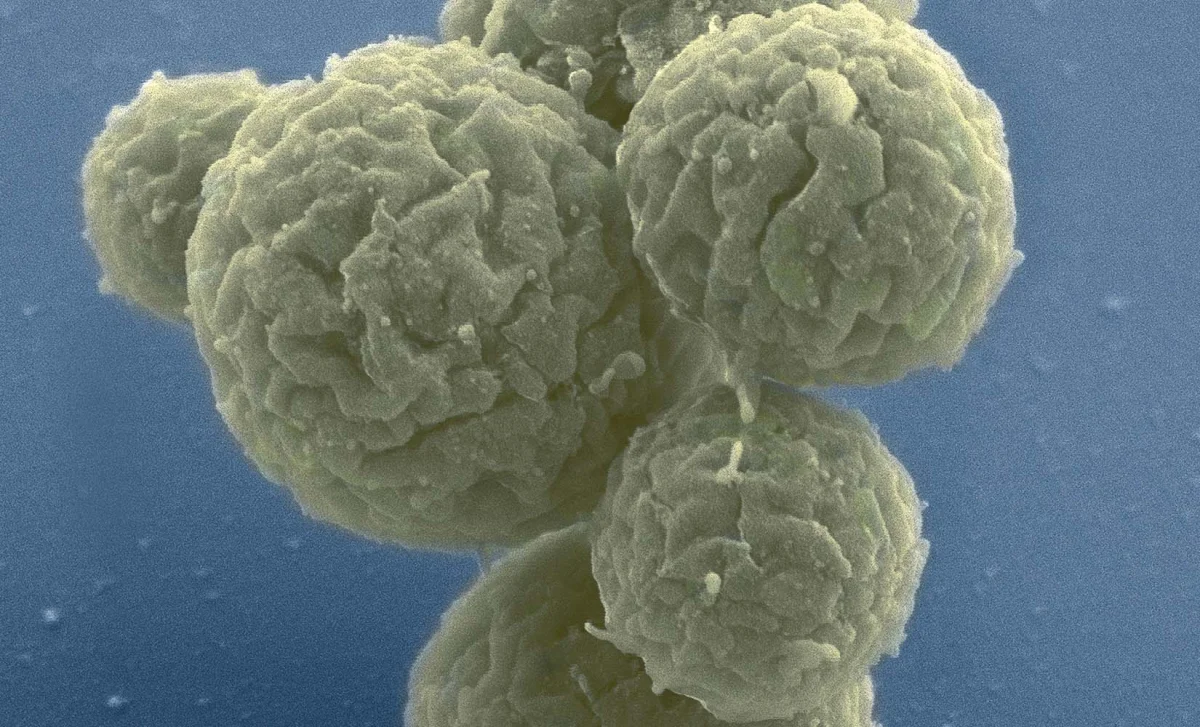
In 2010, Venter’s team inserted a synthetic genome into a normal living cell. That experiment did not create a cell from scratch: the receiving cell already supplied the surrounding structure and machinery. In 2016, the institute reported a minimal synthetic bacterial cell, again using a pre-existing cell into which synthetic genetic material was placed. It contained 473 genes, but it divided irregularly and grew into large, misshapen forms. By 2021, the group had added 19 genes, including seven associated with cell division, and the cell split more normally.
The work showed how much cell behavior depends on genes whose roles may not be obvious until they are removed or changed. It also showed that a stripped-down genome can produce unexpected results. Before his death, Venter said he hoped future research would make cells more directly from the ground up, without first clearing a living cell and inserting new DNA. He also pointed to possible uses for cells given genetic instructions to make medicines, chemicals, construction materials or food. Those ideas depend on advances that have yet to be made.
The distinction between a synthetic genome and a synthetic cell is central. Replacing the genetic material in a living cell changes a major part of the organism, but the existing cell still provides the machinery needed to stay alive and reproduce. A cell assembled from nonliving components would need to build and maintain the systems that carry out those jobs. SpudCell moves toward that challenge by placing several functions in a designed compartment, while still relying on a prepared enzyme mixture and other supplied materials.
Could life use different chemistry?
Juan Pérez-Mercader approaches the problem from physics and chemistry. A senior research fellow at Harvard, he began by writing equations to describe properties commonly associated with life: handling information, reproducing, evolving and using energy. Computer models built from those equations produced digital single-celled forms that could swim. He then asked whether chemistry could reproduce some of the same behaviors.
His laboratory deliberately avoids standard biological ingredients such as DNA, RNA, proteins, sugars and lipids. Pérez-Mercader wants to test whether life-like properties depend on familiar Earth biology or can arise from other chemical materials. His team found a method called polymerization-induced self-assembly. In broad terms, light helps carbon-based molecules link into polymers, which then organize into small compartments called micelles.
The molecules have parts that interact differently with water. As they join, water-attracting sections face outward and water-resistant sections turn inward. This arrangement allows the structures to form enclosed spheres. Continued chemical reactions thicken the micelles and increase pressure inside them. Eventually a portion can separate and form a new structure. The resulting compartments vary slightly from one another, and light supplies energy to the process.
Pérez-Mercader argues that the system brings together simplified versions of reproduction, variation and energy use without relying on familiar biological chemistry. The structures can grow in the presence of light and food, develop into thicker compartments and release what he calls spores, which can grow into new micelles and then vesicles. Whether this counts as life remains disputed. The system lacks the standard molecular features used to study known organisms, and some researchers may reserve the word “life” for systems with a different set of characteristics.
That disagreement reflects a wider tension. Researchers who focus on Earth’s origins can be criticized for assuming that life elsewhere must use the chemistry found here. But proposals that move far from known biology can be difficult to compare with established examples of life. Robert Dorit, a biologist at Smith College, argues that the definition should not be tied too narrowly to familiar organisms. Still, he considers the label “alive” less revealing than what an unusual system can teach us about how living systems work.
That perspective is useful even if scientists never agree on one boundary. A system that grows, divides or uses energy without DNA and proteins could help test whether those features are necessary for life or simply one solution that evolution produced on Earth. It could also sharpen the search for signs of life beyond our planet. Pérez-Mercader sees his work as a test of whether familiar life-like properties can arise from different chemistry, though that interpretation remains a claim to be assessed by other researchers.
How researchers will judge the results
Deciding whether a cell-like system is alive is not only a matter of terminology. Researchers need measurements that can show what a system can do, how reliably it does it and which components are responsible. Strychalski’s group studies ways to measure and troubleshoot engineered cells, as well as how evidence might support a judgment about whether a system is living.
That is a difficult measurement problem because researchers are building with materials also found in natural organisms. A test for cell growth, genetic copying or metabolism may capture one important function without establishing that a system is independent or self-sustaining. A useful set of measures would need to distinguish a structure that performs a single task under supplied conditions from one that maintains itself, reproduces and changes across generations.
At a Build-a-Cell workshop, Strychalski said some teams appeared close to assembling living cells from nonliving materials. The remaining difficulty is still getting every part to work together on its own. For now, the research community can track specific capabilities more clearly than it can settle the broader question. SpudCell’s cycle is a concrete result; calling it life would go beyond what its reported abilities establish.
Safety questions grow with capability
Researchers also have to consider what a more capable synthetic cell could do beyond its intended setting. For SpudCell, Adamala has said that safeguards will be needed if it becomes better able to grow and divide. Such measures would aim to keep the system from reproducing outside a controlled environment. At present, SpudCell’s dependence on supplied ingredients and its limited ability to pass on its full genome are important constraints, but future versions could behave differently as the design changes.
A separate concern comes from so-called mirror biology. Known biological molecules have consistent three-dimensional orientations: genetic material and the amino acids in proteins follow different directional patterns. Some scientists have begun studying the opposite forms of these molecules. A complete mirror cell is not an immediate prospect; the researchers who raised the issue estimated it could be at least a decade away. But a system with reversed chemistry could interact with familiar organisms in unexpected ways.
A 2024 paper in Science, signed by Adamala, Szostak, Venter and many other researchers, discussed possible hazards from mirror life. The authors raised the possibility that mirror organisms could evade natural defenses or spread through ecosystems in ways that are hard to predict. These are prospective risks, not evidence that such cells currently exist. The paper called for researchers to consider safeguards before the field reaches the point where complete mirror cells can be built.
Strychalski has argued that laboratories need better ways to notice an accidental release of engineered biological material. The concern is part of a wider discussion about how research can produce both useful capabilities and harmful ones. The practical question is how to match oversight and containment to what a system can actually do, and to update those measures as its ability to grow or reproduce changes.
For now, the field has no agreed test that will settle whether a constructed system has crossed the line into life. Researchers can still make progress by stating exactly what their systems do, identifying where they depend on supplied materials, and testing whether those functions persist over generations. SpudCell brings feeding, growth, DNA copying and division into one nonliving-ingredient system. The next advance will depend on making those processes more independent and durable—and on measuring the result carefully enough that scientists can explain what they have built.