AI-Designed Proteases Show Promise, While Atomic-Level Tools Aim to Improve Enzyme Design
Two studies report AI-designed protein-cutting enzymes, while RFdiffusion3 adds atomic detail to enzyme design. The results remain early and need cell testing.
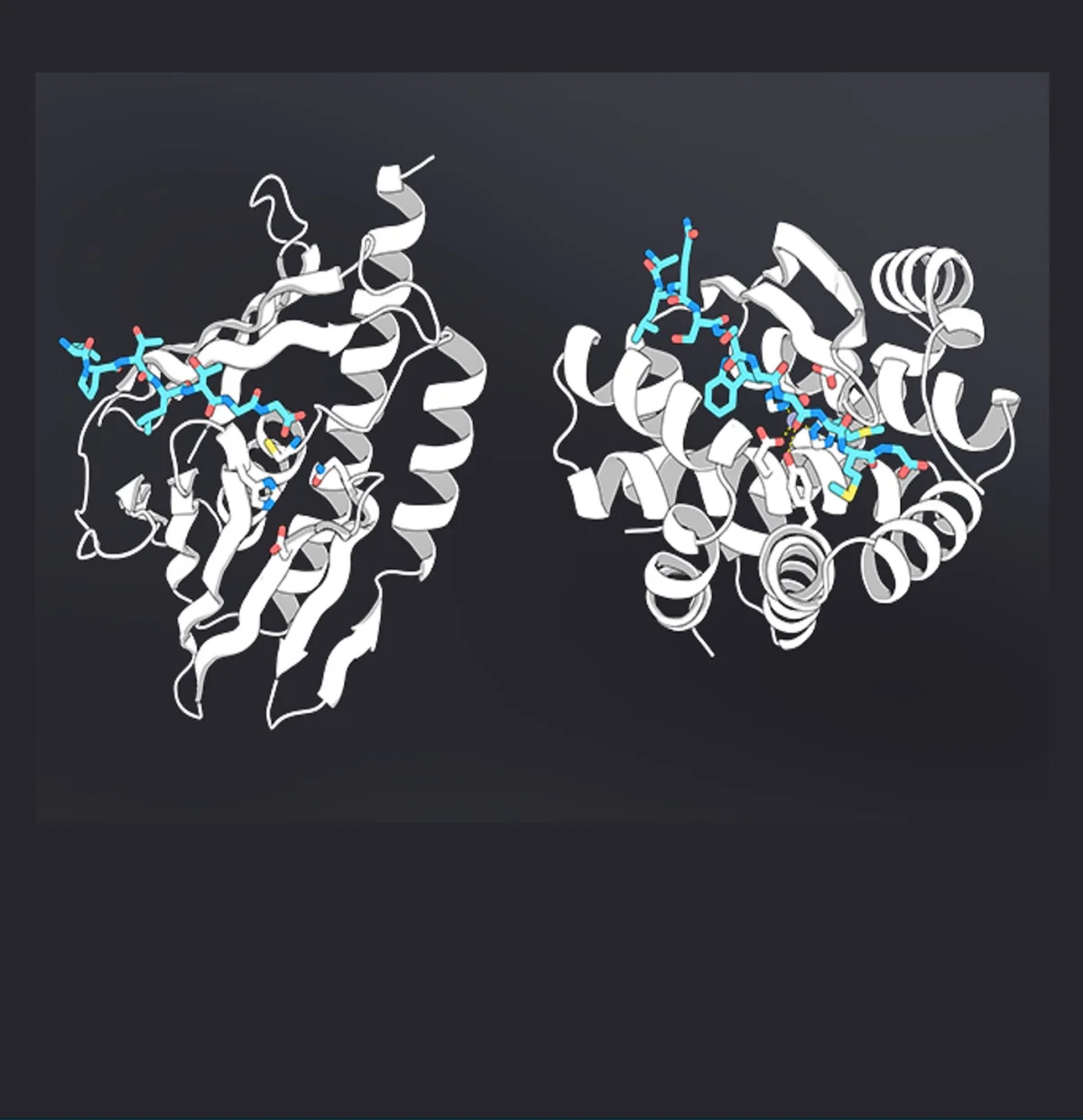
AI-designed enzymes have begun to do more than resemble useful proteins on a computer: in laboratory experiments, some cut specific protein targets. Two studies from David Baker’s lab at the University of Washington describe designed proteases, enzymes that act like molecular scissors. A separate study introduces RFdiffusion3, a design tool that works with detailed atomic representations. Together, the work suggests a path toward custom molecular tools, while also showing how difficult it remains to make new enzymes work efficiently.
The potential applications include breaking down disease-related proteins or building sensors and other biological tools. But these findings are early-stage research. The reported enzyme activity was measured in test tubes, and the designs still need evaluation in cells and, eventually, further research before any medical use could be considered.
Two ways to cut proteins
Proteases break the chemical bonds that connect amino acids in proteins. Their catalytic core carries out the cut, while other parts help the enzyme find and position its target. A small error in the arrangement of those parts can prevent the reaction from working. That makes proteases more challenging to design than simpler protein shapes: an enzyme must not only fit its target but also support the chemical steps that cause a reaction.
The Baker lab team designed two kinds of protease, drawing on enzymes found in crayfish digestion and yeast. One design uses zinc to help drive the reaction. The other, a cysteine protease, forms a short-lived chemical intermediate with its target, making a bond easier to break. Both approaches require particular amino acids to sit in precise positions around the catalytic core.
Using the lab’s RFdiffusion2 design tool, the researchers created new protein backbones around each core to help the enzymes dock with their targets. AI tools helped choose amino acids suited to those structural requirements. The researchers repeated the design process and used AlphaFold3 to predict the resulting structures. Most of the predicted designs looked unlike known proteins, suggesting they weren’t simply reproducing familiar natural structures.
The experimental results were mixed. Thirteen designed cysteine proteases were active in test tubes, a success rate of 19 percent, though each worked less efficiently than the yeast enzyme that inspired the design. Zinc proteases proved harder to engineer: the team had to adjust amino acids near the catalytic core to make room for another participant in the reaction. Of 135 candidates, 36 percent cut their intended targets precisely.
One zinc protease target was amyloid-beta, a protein that can form harmful clumps associated with Alzheimer’s disease. The best designs sped up its breakdown by roughly 100 million times compared with the target’s natural breakdown rate. That is a result from a controlled laboratory reaction; it doesn’t show that the enzyme can remove amyloid-beta in the brain or improve health in people.
The team also tested designed proteases against proteins associated with Alzheimer’s and ALS, a motor neuron disease. In cells, the enzymes acted as switches for inflammation-related proteins: a precise cut activated them and changed cell behavior. These experiments point to possible ways to control protein activity, but they don’t establish a treatment for either disease.
Proteases could have a practical advantage over some protein medicines. A single protease molecule can cut multiple target molecules, whereas an antibody typically binds to its target. That repeated activity could mean less enzyme is needed in a given reaction. Whether this advantage holds in the body depends on factors the test-tube results don’t resolve, including delivery, stability, safety, and how the enzyme behaves around other proteins.
Designing with more atomic detail
The separate RFdiffusion3 study addresses one reason enzyme design remains difficult: many existing design tools work mainly by arranging amino acids, even though enzyme activity depends on fine-grained interactions among atoms. RFdiffusion3 uses atoms as its basic units when generating a protein’s backbone and side chains, giving researchers a more detailed way to specify the shape and chemistry around an active site.
The model represents each amino acid with 14 atom positions: four for the backbone and 10 for its side chain. This is a structured approximation, rather than a record of every atom’s movement. The additional detail lets researchers set atomic positions around a catalytic core and guide which amino acids appear where. The aim is to provide blueprints that account more closely for the contacts needed to make a reaction happen.
In test-tube experiments, the team used RFdiffusion3 to design an enzyme that breaks down paraoxon, an environmental pollutant. The researchers supplied quantum chemistry data to help model how the enzyme changes shape during the reaction. Four candidates showed activity on the first attempt; the team then refined them for speed and precision.
A second test focused on a zinc protease designed to cut a protein that can misfold and clump in conditions affecting the kidneys, heart, and nerves. Of 96 designs, 56 cut more than 10 percent of the target. That is a modest level of activity, but it shows that some from-scratch designs can perform the intended reaction under laboratory conditions.
RFdiffusion3 can also design proteins alongside other molecules, including DNA, RNA, and drugs, while accounting for the atomic details of their interactions. That could help researchers shape a protein for the molecular partners it needs to work with. The lab describes the tool as potentially useful across a range of biomolecule design tasks; its broader value will depend on how well designs hold up in experiments.
What the results establish
The studies show that AI can help produce new protein designs with measurable enzyme activity, including proteases that cut selected targets. They don’t yet show reliable, efficient enzymes for treating disease. Many candidates failed or performed below natural enzymes, and the reported results are largely from test tubes. The cell experiments offer an additional early step, not evidence of benefit in people.
The next test is whether these designs remain active and selective in the more complex conditions inside cells. For readers following this research, the clearest takeaway is that atomic-level design may improve scientists’ ability to build molecular tools, while experimental testing still determines which designs actually work.